Compassion

Tuesday, August 20, 2013

New Research Suggests Sight Matters More Than Sound for even Classical Musicians

Science in Musical Performance

After 20 years of competitions and performing as a professional concert pianist, psychologist Tsay connected some very interesting elements of sight and sound and how they combine in the best players.

She performed several different experiments, with both novice and experienced listeners, and determined that it was easier for all involved to identify competition winners/best players by pure sight alone. That's right - video, without sound.

But wait, you say...it's MUSIC. Isn't that purely - by definition - a sound quality? Why on earth would sight matter?

Turns out that accessing music with our eyes better conveys the elements of passion, motivation and creativity - the benchmarks of outstanding performances.

You can read the full article above for more specific details, but this truly strikes something within me. I'm not sure it's a nerve, but I'm not sure it's a good one either.

Obviously passion, motivation and creativity are incredibly important in all areas of life and music is no exception, but I'm confused as to why this comes through visually rather than through sound. Everything we teach students - even visual aspects such as posture - is used solely to ensure the best possible sound quality. That's what we tell them. That's what we've always been told. Music is worth nothing if it doesn't sound right. But this article seems to prove that in our society, once again, it doesn't matter what a person does, as long as they look right doing it.

(This can be argued quite effectively, however, by taking any well-trained musician to a movie where one of the main Hollywood stars is meant to be a famous violinist, or cellist, or pianist, or trumpeter or whatever have you. We can always tell when the person really has no idea what they're doing. If you have doubts and want some laughs - check out this tumblr whose posts revolve around actual "professional" photos of people pretending to know what to do when a violin is put in their hands: http://stockphotosofviolinists.tumblr.com/)

How does this change how we teach our students to perform their music? Should it change how we teach students? Should the focus now become on how to make playing "look good" instead?

This reminds me of Joshua Bell, famous violinist, who traded the stage lights for florescent ones in the subway - and NO ONE NOTICED.

But there's also the flip side. What of someone who performs every single note with perfect precision and emotion, and yet uses minimum movement such as would not have been noticed whatsoever by any of the people in this experiment, or the competition judges? What do we tell that student? That his perfect music isn't good enough? That we need to actually SEE her heart on her sleeve? How can we punish them for doing something completely right - and yet so utterly wrong?

How can we reconcile quality of sound with what the world notices?

Wednesday, March 13, 2013

Article on Band's Secondary Attention

NPR - School Bands Should Not Be Entertainment Adjunct for Sports

This short article/talk transcript from NPR discusses one of many cases where students who did not want to participate in Marching Band and/or perform at the football half-times were not allowed to join any of the other music groups such as concert band or the school orchestra.

The main pull of the article's opinion is that music is good in its own right, and doesn't have to be "entertainment" between sports rounds for it to be worth anything, and that forcing students to be such pawns is inexcusable.

But it's not just the marching band entertainment ploy that bothers me. It's how schools, high school and university level, will give many scholarships for their sports players and hardly any to deserving musicians, or certainly much less money per scholarship. While there may not be as much physical risk involved in sports, I'd like to argue that musicians actually have to pay for their own instruments and upkeep thereof, whereas many athletes can rely on school funds to cover many of that. Likewise, many sports trips have no cost to the student whatsoever, whereas student musicians must fundraise and fundraise and fundraise in the hopes of going to a competition they've been accepted into or a trip outside their own neighborhood, or heaven forbid and overseas tour!

Music trips such as these can bring just as much positive publicity as sports games and lead to a great number of potential students and sponsors. Who wants to give money to something that they've never seen or heard? When we put it out there and give it a priority, people pay attention, and they give it what it's due.

But there in lies the problem: sadly, music is NOT a priority. Not for universities, not for high schools, and certainly not for middle schools and elementary schools.

I could go into so many rants about our current education system focused on test scores and eliminating all essential brain-stimulation and "extra"curricular activities and even physical activity or just being a child (called recess), but that would take me an hour and I'm not sure anyone reads this blog anyway, so I will keep my opinions to myself for now.

As for this debate of the value of music vs. sports, or rather, as I'd like to challenge, music AND sports (why can't we value both?!), I'd love your opinions. :-)

Saturday, March 9, 2013

Band is Best

Beating the Drum

Closing argument for why the best extracurricular activity is band, and more specifically, marching band: Experts say that the key to high school success is rigor, relevance and relationships. Band hits on all three: It offers the rigor of learning to play music while marching in complex formations; the relevance of the discipline and team skills that benefit teens long after high school, and relationships that can  develop and deepen over all four years of high school.

Absolutely all of my best memories from elementary up through college have been those where I was involved in music. I have met some of the best (and worst, but mainly best) people. A lot was expected of us, and we rose to the challenge. We stayed busy, and that kept most of us out of trouble. And the empathy that music encourages is only one of the hundred things that will benefit me for the rest of my life.

Sunday, February 17, 2013

Compromising Polyrhythm


I distinctly remember the first time I was introduced to the musical polyrhythmic idea of playing triplets against eighth notes. I was a young student, probably ten, at summer orchestra camp where they had a short theory lesson each morning. The teacher explained the concept, modeled it, and had us try it. I was...unsuccessful, to say the least. It was frustrating. I could play one or the other, or clap one or the other, but I could not for the life of me put them together. I gave up quite quickly and the professor could not convince me that this was a skill I would need.

To help you understand this technique, try this youtube video: Polyrhythm Grafic
Or, if that one gives you metronome nightmares (admit it, we all have those. It's like the musicians' version of going through your whole day naked), try this piano version: 2 against 3

Skip forward a few years and allow me a short digression that I promise will come back full circle. Star Wars Episode II came out when I was 13. Lucas has said that he specifically marketed this particular film for 12-14 year olds, trying to bring the next generation into the fanworld. This is my main excuse for it being my favorite Star Wars movie of all times. Now before you bite my head off on the merit of that particular statement, please be aware that I watch it now and logically understand how EpVI is so much better in terms of storyline and such, but my heart will not let me back away from my love of EpII. I watched that movie every single afternoon of 7th grade. I can still quote the entire thing verbatim. I listened to a single song from the orchestral soundtrack for over a year and a half straight (oh how I wish iTunes track count existed back then. The sheer number of hours must be embarrassing): Across the Stars, the love theme.

(on the off-chance someone here doubts the brilliance of John Williams, take a listen on youtube here: Across the Stars - London Symphony Orchestra)

So you can imagine my surprise and utter glee when I found the sheet music for Across the Stars and my father bought it for me. The happiness quickly turned into frustration when I realized that nearly the whole piece was triplets against eighth notes. (the constant underlying harp/cello part is triplets, most of the melody is eighths) Now I really regretted not paying closer attention to that summer music theory class.

It took me a month of struggling and fighting and wanting to give up, but my love of the music made me persevere and finally it paid off.

I have never since had trouble with the triplet against eighth note rhythm.

Which leads us directly into today's Band Director quote:

Jacqueline (Doc's wife, who plays bass clarinet, remember?) typically does not say much during rehearsals.She is there because she enjoys playing her instrument and likes helping her husband in his work. Sometimes though, she can't help herself.

"What are you doing at measure 87? Because we have triplets but you're conducting eighths!"
Doc: "Yeah, I am."
Jacqueline: "Well don't do that!"

This made everyone laugh a bit at Jacqueline's desperation, which we all felt. But, Doc obviously learned that sometimes compromise is the best solution in both marriage and music.

Doc: "Okay, I'll compromise. I won't subdivide beat 4 but I will conduct the 8ths on beat 5."

Which we then ran through. When we finished the section, Doc smiled. "That was nice!"

Jacqueline agreed. "Yeah it was!" 

We snickered, and then ran the piece from start to finish.

At the end, Doc kept his baton up, holding, holding, waiting so long I couldn't even hear any inkling of an echo of a single note in the room. And that was the moment that Doc whispered, "I think we've got it."

And got it we did.


Monday, January 7, 2013

Memorization - Do or Do Not?

Memorizations Loosening Hold On Concert Tradition

This is a New York Times article about memorization. Not even about the benefits or the negative aspects surrounding it, but merely the main history to performing solo works only by memory, what places have gone lack on the social requirement and others that haven't. Interestingly to note, it seems that the general public could care less about memorization as long as the performance is meaningful, and yet it is the schools which train young musicians that are holding steadfastly to the memorization rule.

Now to be fair, at least on a University level, I've seen that this rule tends to be held more strictly for pianists and strings. Memorization is like, the one little break most wind players get. Now, if we do a concerto competition or something, we usually still have to, but for recitals or juries using scores is no big deal.

Personally, I have memorized pieces, and I actually find it easier on piano and violin to an extent. Piano tends to be easier because it usually requires more work and time to perfect a piece due to the complexity of everything being in your hands (literally) whereas on a woodwind, while I may use all or most of none of my fingers to create a note and have to deal with embouchure and breathing etc, I still only have that one note to worry about. On piano, by the time I've fine-tuned a piece, it's pretty close to being memorized. As far as violin playing goes, the easiness is either due to the two years I spent learning fiddle tunes in the Blue Ridge Mountains (fiddle tunes are rarely written down, they are merely played by the teacher over and over until the student has memorized the pattern and begun to manipulate it themselves - aka improvisation) or the fact that most string players start their craft at such a young age that they begin learning by ear, where everything is memorized. Once you've started in that manner, it's not hard to keep memorizing as you go no matter how advanced you get.

But then again, I wonder if the reason I find it so hard to memorize on bassoon is that I rarely have. When we are not challenged to do something, we rarely do it.

This is not to say that I am for or against memorization. I think it is a skill that all musicians should have in their ready arsenal. Something they can always do if need be, which would require practice. But should it be required? It seems to me that requiring memorization is much like requiring a musician to learn Italian, when really they'd be just fine learning the 20-40 odd Italian words typically found inside scores.

Thoughts? I'd really love to debate on this further.

Hobey-ho!

Wednesday, December 12, 2012

Christmas Carols for the Insane

Just a little humor here to get everyone in the Christmas Spirit!

I've always wondered why my favorite carols are in the minor key...anyone else?

And on a side note, what is everyone's opinion on Picardy Thirds? I personally DETEST them. My most hated musical element by far. I always take them out of my pieces.


CHRISTMAS DISORDERS and CAROLS
1. Schizophrenia — Do You Hear What I Hear?
2. Multiple Personality Disorder — We Three Kings Disoriented Are
3. Dementia — I Think I’ll be Home for Christmas
4. Narcissistic — Hark the Herald Angels Sing About Me
5. Manic — Deck the Halls and Walls and House and Lawn and Streets and Stores and Office and Town and Cars and Buses and Trucks and Trees and…..
6. Paranoid — Santa Claus is Coming to Town to Get Me
7. Borderline Personality Disorder — Thoughts of Roasting on an Open Fire
8. Personality Disorder — You Better Watch Out, I’m Gonna Cry, I’m Gonna Pout, Maybe I’ll Tell You Why
9. Attention Deficit Disorder — Silent night, Holy oooh look at the Froggy – can I have a chocolate, why is France so far away?
10. Obsessive Compulsive Disorder — Jingle Bells, Jingle Bells, Jingle Bells, Jingle Bells, Jingle Bells, Jingle Bells, Jingle Bells, Jingle Bells, Jingle Bells, Jingle Bells, Jingle Bells, Jingle Bells, Jingle Bells, Jingle Bells, Jingle Bells….
11. Oppositional Defiant Disorder– You better not cry – Oh yes I will
You better not Shout – I can if i want to
You better not pout – Can if i want to
I’m telling you why – Not listening
Santa Claus is coming to town – No he’s not!!


Read more: http://blog.beliefnet.com/beyondblue/2010/12/do-you-hear-what-i-hear-christ.html#ixzz2EsL6lGJ5


Hobey-ho!

Wednesday, December 5, 2012

Spit Pups

No excuses for the time lapse...so we're moving on.


It was this past February, and we're all in Wind Ensemble at noon like it's any other Tuesday. We're going through piece after piece, and we get a section that's flute centered. The flutes are in two half-rows, one behind the other, with pics and firsts in the front and second and third in the back. There were probably 5 flutists and a piccolo. And the section just completely falls apart. So Doc starts nagging at the little Freshman girl playing third, and yet it was one of the front row players who's facial expression reacted to the criticism.

And Doc had this to say: "Sorry about spitting on your to get to her!"

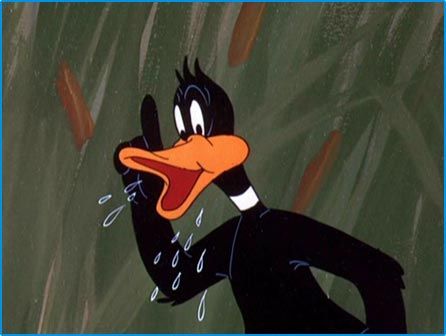
(Normally in music, "spit" refers to the condensation that comes out of your instrument, which of course gives me the perfect opportunity to place two cartoons here as an interjectory to this little post:


Alright, had a good little laugh now? *End digression*)

But Doc was not finished with the little freshman in the back, and quickly returned to fulfill the whole purpose for stopping the rehearsal in the first place. "She needs a little help to get that puppy in the pile!"


(A moment for all the ladies to go "awwwwwwwwww!")

And of course, him saying that made me imagine all of the flutes following the Pied Piper into a pile of their own:

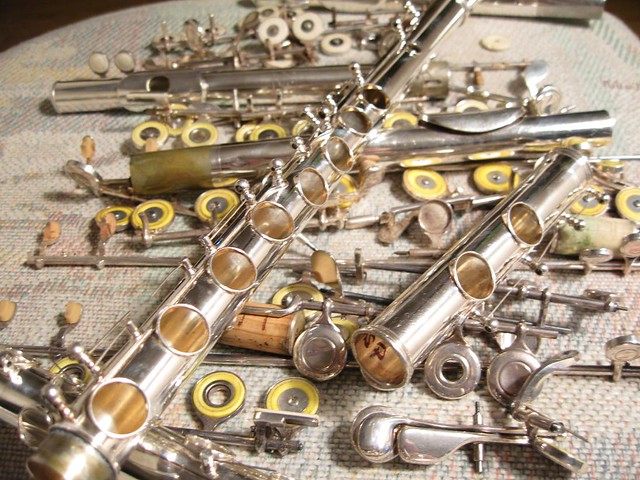
(sorry for the flute carcasses)

We did the section over again, and either the little fluitist was terrified into submission, or Doc just figured he'd punished her enough for the day, and we moved on. But I think whatever she had spread to the rest of the group.

Just before class time was over, Doc commented on the fact that we weren't holding notes all the way to the downbeat and really putting holes all over our phrasing, and he gave us the really depressing face mixed with disbelief that we were all college students - many of us music majors - all with several years of music experience under our belts.

"If we can't play whole notes by now, we haven't made it."

(Whole notes are, quite frankly, the easiest value of note to figure out. A whole note takes up an entire measure, basically, unless you want to get into the really complicated time signatures and compositions that no one will see unless you're a music major or a professional musician, so I won't waste your time. Whole notes are what you learn first when playing an instrument, because it gives you tons of time to listen to tone and look-up the fingering for the next note coming in 4 beats.)

Since there's no way to argue that...we just didn't look at him, and he let us finish out the piece with a little bit of dignity before sending us out the door with our tail between our legs. 
(sorry, couldn't resist another cute puppy pic!)

Hobey-ho!