Why the progress in the practice room seems to disappear overnight
This is a fantastic article on Bulletproof Musician written by clarinetist Dr. Christine Carter. In it, she talks about what we have been doing for practicing and why it isn't working. (this in and of itself is nothing new) What is life-changing is that she then goes on to explain something called Random Practice which is all about practicing the same stuff in the same amount of time, but randomly so that our brain stays active and alert through the whole thing.
WHY HAVE I NEVER HEARD THIS BEFORE?!
It is so simple. And it gives me such hope.
I'm not sure it will take the monotony out of certain practice elements (*cough scales cough* although I do love my lower octave 9-note segments, don't ask me why), and I know it will take an adjustment period to retrain my practice sessions, but just reading this article excited me so much I wanted to take my bassoon out and start practicing right away (but I have contained myself, given that it is 1:15am...).
Has anyone used this new practice technique? What are your thoughts on it? Does it work? What are the pros and cons?
GIVE ME KNOWLEDGE! :-)
Hobey-ho.
Thursday, October 17, 2013

Monday, October 14, 2013
No help for the Music Majors
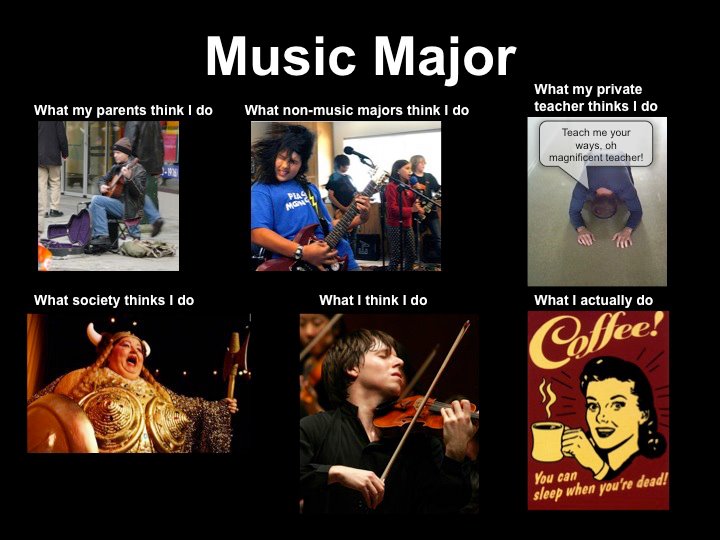
Sometimes, especially during the intensive undergrad years, we frequently forget that we picked this major because we enjoy music. I mean, that's the best part about college, right? That we get to study the thing we want to study? But between theory and music history and counterpoint and 47 million hours of rehearsals each week, it can just get plain exhausting. We get lost in the trees instead of frolicking in the forest, just playing notes instead of feeling the music. Which is not necessarily a skill that helps when playing wind ensemble music, as Doc pointed out on day.
"It's much more fun than you're making it. You're hiding from it guys." (I wish Blogspot would let us upload .gifs here. If there is a way to do it, please someone let me know. Otherwise, I'll just be over on Tumblr and leave this here for you: Hamster)
Later on in the piece, there was a very fast double tongue/complicated rhythm thing for the poor trumpets where they had the poly-rhythm on top of the rest of the band's simple rhythm and they just could not keep it together. At the time (almost 2 years ago - such shame!), we had five trumpets, two of whom were music majors. At such a small school, non-music majors fill over half the slots in all of our ensembles. We are very grateful for them, but sometimes it shows that they're not in private lessons or practicing 18 hours a day - although, let's get real, nobody does that but that weird Asian violinist or the the piano prodigy anyway - and this was one of those times.
So Doc tried to help them out and offered them a cheat. After running it that way, he proclaimed, "I like that fix on that, if you need it, use it. Those of you who are music majors have to play what's on the page." And then he gave this grin that was like, so pleased with himself for making life harder on those poor overworked students.

Afterwards, we ran the section again, and it was even better than before. Doc was shocked and spoke to the trumpets again. "That was acceptable. But it hasn't been up to this point. Why? You just wanted attention, huh? I understand."
Because I mean, really, what trumpeter doesn't?

*Disclaimer: Attitudes and statements on this blog are not necessarily representative of the blog creator and are merely representations of other's opinions. I am not a trumpet player. Nor do I want to be one.


Just so we're all clear.
Hobey-Ho!
Thursday, October 10, 2013
What Is Classical Music's Women Problem?
What Is Classical Music's Women Problem?
This article actually really bothers me. I’ve been conducting handbells at all levels (beginner through advanced) for 3 years, something I never expected to do, and it’s been one of the most amazing and challenging and rewarding things I’ve ever done. And I’ve never gotten this sexism crap from anywhere else in the music world, so it came as a complete surprise. What the heck does my being female have to do with waving a stick to the proper beat and expressing musical concepts? I thought we did away with all of that along with the colonial age once women were allowed to play any instrument regardless of how their neck looked while doing it. This article felt like a literal punch to the gut and I almost cried, but then I remembered Betty White’s quote (I don’t think she was the first to say it, but she made it memorable and nobody remembers the other person):
"Why do people say ‘grow some balls’? Balls are weak and sensitive. If you really wanna get touch, grow a vagina. Those things take a pounding."
And then I said to myself, “Screw them. You’ve been trained for this. You live for this. Keep doing it.”
Wednesday, October 9, 2013
Music Joke

So a C, an E-flat and a G walk into a bar. The bartender says, "sorry, but we don't serve minors." So E-flat leaves, and C and G have an open fifth between them. After a few drinks, the fifth is diminished and G is out flat. F comes in and tries to augment the situation, but is not sharp enough.
A D comes in and heads for the bathroom saying, "Excuse me. I'll just be a second." Then A comes in, but the bartender is not convinced that this relative of C is not a minor. Then the bartender notices B-flat hiding at the end of the bar and says, "Get out! You're the seventh minor I've found in this bar tonight."
E-Flat comes back the next night in a three-piece suit with nicely shined shoes. The bartender says, "you're looking sharp tonight. Come on in, this could be a major development." Sure enough, E-flat soon takes off his suit and everything else, and is au natural. Eventually, C, who had passed out under the bar the night before, begins to sober up and realizes in horror that he's under a rest.
So, C goes to trial, is convicted of contributing to the diminution of a minor and sentenced to 10 years of DS without Coda at an up scale correctional facility. The conviction is overturned on appeal, however, and C is found innocent of any wrongdoing, even accidental, and that all accusations to the contrary are bassless.
The bartender decides, however, that since he's only had tenor so patrons, the soprano out in the bathroom and everything has become alto much treble, he needs a rest and closes the bar.
Monday, October 7, 2013
Diving Bruises
New goal: at least one new quote a week. I am over a year and a half behind in my archive, so that should be easy. No excuses, because you wouldn't want to hear them anyway.
On day in rehearsal, Doc was talking to some of the brass players. We had just come back from a weekend off, and our lack of chops were proving themselves. "Use what you gotta use, but don't bruise."
Which would've been helpful if we'd had any to use, but regardless, I'm pretty sure we all left rehearsal not wanting to talk for a week. (okay...so I probably held off the talking for like 3 minutes...but that's a record for me!)
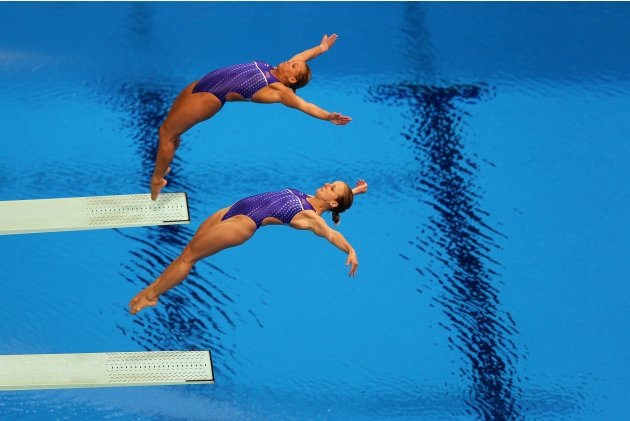
The licks still weren't getting any better. Doc tried to motivate us on a tricky rhythm. "No heroes here. I need a 9.8 dive at least. or what did they change it to, is it 5 is perfect now?"
We just stared at him, obviously proving that we are poor college students living in a dorm with no tv/cable and having no idea of any new (or old) Olympic rules. Doc sat in the silence for a moment, then continued unabashed. "I guess it's 10. So 9.8's okay? No belly flops here please. Dum digati dum."

(Just envision this guy with a trumpet, and you'll know what we sounded like. You're welcome.)
Once again, sorry for the prolonged hiatus. It's hard to stay motivated when I'm not sure if anyone's even reading this blog or not... *insert shameless plug here*
Hobey-ho!
Tuesday, August 20, 2013
New Research Suggests Sight Matters More Than Sound for even Classical Musicians
Science in Musical Performance
After 20 years of competitions and performing as a professional concert pianist, psychologist Tsay connected some very interesting elements of sight and sound and how they combine in the best players.
She performed several different experiments, with both novice and experienced listeners, and determined that it was easier for all involved to identify competition winners/best players by pure sight alone. That's right - video, without sound.
But wait, you say...it's MUSIC. Isn't that purely - by definition - a sound quality? Why on earth would sight matter?
Turns out that accessing music with our eyes better conveys the elements of passion, motivation and creativity - the benchmarks of outstanding performances.
You can read the full article above for more specific details, but this truly strikes something within me. I'm not sure it's a nerve, but I'm not sure it's a good one either.
Obviously passion, motivation and creativity are incredibly important in all areas of life and music is no exception, but I'm confused as to why this comes through visually rather than through sound. Everything we teach students - even visual aspects such as posture - is used solely to ensure the best possible sound quality. That's what we tell them. That's what we've always been told. Music is worth nothing if it doesn't sound right. But this article seems to prove that in our society, once again, it doesn't matter what a person does, as long as they look right doing it.
(This can be argued quite effectively, however, by taking any well-trained musician to a movie where one of the main Hollywood stars is meant to be a famous violinist, or cellist, or pianist, or trumpeter or whatever have you. We can always tell when the person really has no idea what they're doing. If you have doubts and want some laughs - check out this tumblr whose posts revolve around actual "professional" photos of people pretending to know what to do when a violin is put in their hands: http://stockphotosofviolinists.tumblr.com/)
How does this change how we teach our students to perform their music? Should it change how we teach students? Should the focus now become on how to make playing "look good" instead?
This reminds me of Joshua Bell, famous violinist, who traded the stage lights for florescent ones in the subway - and NO ONE NOTICED.
But there's also the flip side. What of someone who performs every single note with perfect precision and emotion, and yet uses minimum movement such as would not have been noticed whatsoever by any of the people in this experiment, or the competition judges? What do we tell that student? That his perfect music isn't good enough? That we need to actually SEE her heart on her sleeve? How can we punish them for doing something completely right - and yet so utterly wrong?
How can we reconcile quality of sound with what the world notices?
After 20 years of competitions and performing as a professional concert pianist, psychologist Tsay connected some very interesting elements of sight and sound and how they combine in the best players.
She performed several different experiments, with both novice and experienced listeners, and determined that it was easier for all involved to identify competition winners/best players by pure sight alone. That's right - video, without sound.
But wait, you say...it's MUSIC. Isn't that purely - by definition - a sound quality? Why on earth would sight matter?
Turns out that accessing music with our eyes better conveys the elements of passion, motivation and creativity - the benchmarks of outstanding performances.
You can read the full article above for more specific details, but this truly strikes something within me. I'm not sure it's a nerve, but I'm not sure it's a good one either.
Obviously passion, motivation and creativity are incredibly important in all areas of life and music is no exception, but I'm confused as to why this comes through visually rather than through sound. Everything we teach students - even visual aspects such as posture - is used solely to ensure the best possible sound quality. That's what we tell them. That's what we've always been told. Music is worth nothing if it doesn't sound right. But this article seems to prove that in our society, once again, it doesn't matter what a person does, as long as they look right doing it.
(This can be argued quite effectively, however, by taking any well-trained musician to a movie where one of the main Hollywood stars is meant to be a famous violinist, or cellist, or pianist, or trumpeter or whatever have you. We can always tell when the person really has no idea what they're doing. If you have doubts and want some laughs - check out this tumblr whose posts revolve around actual "professional" photos of people pretending to know what to do when a violin is put in their hands: http://stockphotosofviolinists.tumblr.com/)
How does this change how we teach our students to perform their music? Should it change how we teach students? Should the focus now become on how to make playing "look good" instead?
But there's also the flip side. What of someone who performs every single note with perfect precision and emotion, and yet uses minimum movement such as would not have been noticed whatsoever by any of the people in this experiment, or the competition judges? What do we tell that student? That his perfect music isn't good enough? That we need to actually SEE her heart on her sleeve? How can we punish them for doing something completely right - and yet so utterly wrong?
How can we reconcile quality of sound with what the world notices?
Wednesday, March 13, 2013
Article on Band's Secondary Attention
NPR - School Bands Should Not Be Entertainment Adjunct for Sports
This short article/talk transcript from NPR discusses one of many cases where students who did not want to participate in Marching Band and/or perform at the football half-times were not allowed to join any of the other music groups such as concert band or the school orchestra.
The main pull of the article's opinion is that music is good in its own right, and doesn't have to be "entertainment" between sports rounds for it to be worth anything, and that forcing students to be such pawns is inexcusable.
But it's not just the marching band entertainment ploy that bothers me. It's how schools, high school and university level, will give many scholarships for their sports players and hardly any to deserving musicians, or certainly much less money per scholarship. While there may not be as much physical risk involved in sports, I'd like to argue that musicians actually have to pay for their own instruments and upkeep thereof, whereas many athletes can rely on school funds to cover many of that. Likewise, many sports trips have no cost to the student whatsoever, whereas student musicians must fundraise and fundraise and fundraise in the hopes of going to a competition they've been accepted into or a trip outside their own neighborhood, or heaven forbid and overseas tour!
Music trips such as these can bring just as much positive publicity as sports games and lead to a great number of potential students and sponsors. Who wants to give money to something that they've never seen or heard? When we put it out there and give it a priority, people pay attention, and they give it what it's due.
But there in lies the problem: sadly, music is NOT a priority. Not for universities, not for high schools, and certainly not for middle schools and elementary schools.
I could go into so many rants about our current education system focused on test scores and eliminating all essential brain-stimulation and "extra"curricular activities and even physical activity or just being a child (called recess), but that would take me an hour and I'm not sure anyone reads this blog anyway, so I will keep my opinions to myself for now.
As for this debate of the value of music vs. sports, or rather, as I'd like to challenge, music AND sports (why can't we value both?!), I'd love your opinions. :-)
This short article/talk transcript from NPR discusses one of many cases where students who did not want to participate in Marching Band and/or perform at the football half-times were not allowed to join any of the other music groups such as concert band or the school orchestra.
The main pull of the article's opinion is that music is good in its own right, and doesn't have to be "entertainment" between sports rounds for it to be worth anything, and that forcing students to be such pawns is inexcusable.
But it's not just the marching band entertainment ploy that bothers me. It's how schools, high school and university level, will give many scholarships for their sports players and hardly any to deserving musicians, or certainly much less money per scholarship. While there may not be as much physical risk involved in sports, I'd like to argue that musicians actually have to pay for their own instruments and upkeep thereof, whereas many athletes can rely on school funds to cover many of that. Likewise, many sports trips have no cost to the student whatsoever, whereas student musicians must fundraise and fundraise and fundraise in the hopes of going to a competition they've been accepted into or a trip outside their own neighborhood, or heaven forbid and overseas tour!
Music trips such as these can bring just as much positive publicity as sports games and lead to a great number of potential students and sponsors. Who wants to give money to something that they've never seen or heard? When we put it out there and give it a priority, people pay attention, and they give it what it's due.
But there in lies the problem: sadly, music is NOT a priority. Not for universities, not for high schools, and certainly not for middle schools and elementary schools.
I could go into so many rants about our current education system focused on test scores and eliminating all essential brain-stimulation and "extra"curricular activities and even physical activity or just being a child (called recess), but that would take me an hour and I'm not sure anyone reads this blog anyway, so I will keep my opinions to myself for now.
As for this debate of the value of music vs. sports, or rather, as I'd like to challenge, music AND sports (why can't we value both?!), I'd love your opinions. :-)
Subscribe to:
Posts (Atom)