Compassion

Monday, January 7, 2013

Memorization - Do or Do Not?

Memorizations Loosening Hold On Concert Tradition

This is a New York Times article about memorization. Not even about the benefits or the negative aspects surrounding it, but merely the main history to performing solo works only by memory, what places have gone lack on the social requirement and others that haven't. Interestingly to note, it seems that the general public could care less about memorization as long as the performance is meaningful, and yet it is the schools which train young musicians that are holding steadfastly to the memorization rule.

Now to be fair, at least on a University level, I've seen that this rule tends to be held more strictly for pianists and strings. Memorization is like, the one little break most wind players get. Now, if we do a concerto competition or something, we usually still have to, but for recitals or juries using scores is no big deal.

Personally, I have memorized pieces, and I actually find it easier on piano and violin to an extent. Piano tends to be easier because it usually requires more work and time to perfect a piece due to the complexity of everything being in your hands (literally) whereas on a woodwind, while I may use all or most of none of my fingers to create a note and have to deal with embouchure and breathing etc, I still only have that one note to worry about. On piano, by the time I've fine-tuned a piece, it's pretty close to being memorized. As far as violin playing goes, the easiness is either due to the two years I spent learning fiddle tunes in the Blue Ridge Mountains (fiddle tunes are rarely written down, they are merely played by the teacher over and over until the student has memorized the pattern and begun to manipulate it themselves - aka improvisation) or the fact that most string players start their craft at such a young age that they begin learning by ear, where everything is memorized. Once you've started in that manner, it's not hard to keep memorizing as you go no matter how advanced you get.

But then again, I wonder if the reason I find it so hard to memorize on bassoon is that I rarely have. When we are not challenged to do something, we rarely do it.

This is not to say that I am for or against memorization. I think it is a skill that all musicians should have in their ready arsenal. Something they can always do if need be, which would require practice. But should it be required? It seems to me that requiring memorization is much like requiring a musician to learn Italian, when really they'd be just fine learning the 20-40 odd Italian words typically found inside scores.

Thoughts? I'd really love to debate on this further.

Hobey-ho!

Wednesday, December 12, 2012

Christmas Carols for the Insane

Just a little humor here to get everyone in the Christmas Spirit!

I've always wondered why my favorite carols are in the minor key...anyone else?

And on a side note, what is everyone's opinion on Picardy Thirds? I personally DETEST them. My most hated musical element by far. I always take them out of my pieces.


CHRISTMAS DISORDERS and CAROLS
1. Schizophrenia — Do You Hear What I Hear?
2. Multiple Personality Disorder — We Three Kings Disoriented Are
3. Dementia — I Think I’ll be Home for Christmas
4. Narcissistic — Hark the Herald Angels Sing About Me
5. Manic — Deck the Halls and Walls and House and Lawn and Streets and Stores and Office and Town and Cars and Buses and Trucks and Trees and…..
6. Paranoid — Santa Claus is Coming to Town to Get Me
7. Borderline Personality Disorder — Thoughts of Roasting on an Open Fire
8. Personality Disorder — You Better Watch Out, I’m Gonna Cry, I’m Gonna Pout, Maybe I’ll Tell You Why
9. Attention Deficit Disorder — Silent night, Holy oooh look at the Froggy – can I have a chocolate, why is France so far away?
10. Obsessive Compulsive Disorder — Jingle Bells, Jingle Bells, Jingle Bells, Jingle Bells, Jingle Bells, Jingle Bells, Jingle Bells, Jingle Bells, Jingle Bells, Jingle Bells, Jingle Bells, Jingle Bells, Jingle Bells, Jingle Bells, Jingle Bells….
11. Oppositional Defiant Disorder– You better not cry – Oh yes I will
You better not Shout – I can if i want to
You better not pout – Can if i want to
I’m telling you why – Not listening
Santa Claus is coming to town – No he’s not!!


Read more: http://blog.beliefnet.com/beyondblue/2010/12/do-you-hear-what-i-hear-christ.html#ixzz2EsL6lGJ5


Hobey-ho!

Wednesday, December 5, 2012

Spit Pups

No excuses for the time lapse...so we're moving on.


It was this past February, and we're all in Wind Ensemble at noon like it's any other Tuesday. We're going through piece after piece, and we get a section that's flute centered. The flutes are in two half-rows, one behind the other, with pics and firsts in the front and second and third in the back. There were probably 5 flutists and a piccolo. And the section just completely falls apart. So Doc starts nagging at the little Freshman girl playing third, and yet it was one of the front row players who's facial expression reacted to the criticism.

And Doc had this to say: "Sorry about spitting on your to get to her!"

(Normally in music, "spit" refers to the condensation that comes out of your instrument, which of course gives me the perfect opportunity to place two cartoons here as an interjectory to this little post:


Alright, had a good little laugh now? *End digression*)

But Doc was not finished with the little freshman in the back, and quickly returned to fulfill the whole purpose for stopping the rehearsal in the first place. "She needs a little help to get that puppy in the pile!"


(A moment for all the ladies to go "awwwwwwwwww!")

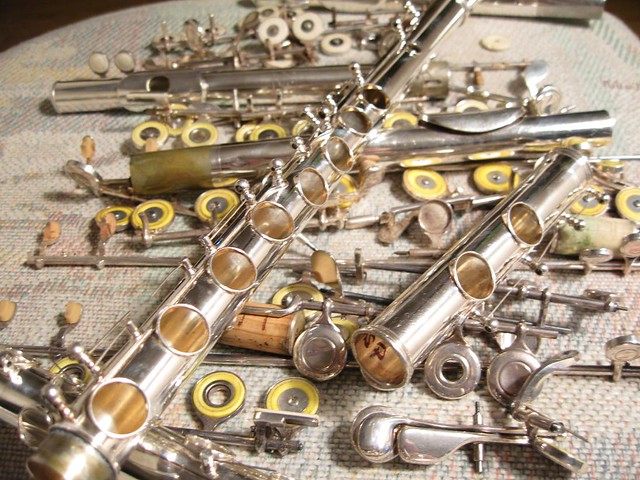
And of course, him saying that made me imagine all of the flutes following the Pied Piper into a pile of their own:

(sorry for the flute carcasses)

We did the section over again, and either the little fluitist was terrified into submission, or Doc just figured he'd punished her enough for the day, and we moved on. But I think whatever she had spread to the rest of the group.

Just before class time was over, Doc commented on the fact that we weren't holding notes all the way to the downbeat and really putting holes all over our phrasing, and he gave us the really depressing face mixed with disbelief that we were all college students - many of us music majors - all with several years of music experience under our belts.

"If we can't play whole notes by now, we haven't made it."

(Whole notes are, quite frankly, the easiest value of note to figure out. A whole note takes up an entire measure, basically, unless you want to get into the really complicated time signatures and compositions that no one will see unless you're a music major or a professional musician, so I won't waste your time. Whole notes are what you learn first when playing an instrument, because it gives you tons of time to listen to tone and look-up the fingering for the next note coming in 4 beats.)

Since there's no way to argue that...we just didn't look at him, and he let us finish out the piece with a little bit of dignity before sending us out the door with our tail between our legs. 
(sorry, couldn't resist another cute puppy pic!)

Hobey-ho!

Saturday, September 29, 2012

I'm not the only one!

Okay, so I know I've been absolutely horrible, and I promise unto all things Holy that I will give a real update soon, but I follow these two hilarious tumblr pages (http://whatshouldwecallbassoon.tumblr.com and http://soyoureachurchmusician.tumblr.com).

And on the latter, I just found this gem:

                           WHEN MY BEST FRIEND AND I LISTEN TO HYMNS IN THE CAR

Plus the even more applicable to this blog/post (which is on the link but I will also copy and paste here for ease of use):

http://soyoureachurchmusician.tumblr.com/post/25621792164/quotes-from-my-choir-director


So, here’s to you Dr. Gray. :)
1. I am not a man, but a worm.
2. You may not like being called a sackbut.
3. The passaggio is a ramp, not a parking lot.
4. You stray from the pack and a predator eats you.
5. Your Eb was like lobbing two hot dogs at a dartboard.
6. ….And you’re up there jivin’ on top.
7. Taste the sin in your mouth.
8. There’s ecstasy in the melisma.
9. When I die, it won’t be breathy. There will be core in my last words.
10. I’m tired of singing all this penitential crap! I wanna sing happy songs! *He wasn’t serious…..*
11. No scratching off in Palestrina.
12. Your Holy Spirit was more like an ostrich.
13. There are no 3rds in the grave.
14. Did your mother have any children who lived?
15. There’s nothing worse than dry polyphony.
16. We don’t have time for such subtleties in the monastery.
17. Asperges me: The liturgical version of “Raindrops Keep Fallin’ on My Head”.
18. The tenors migrate in the Fall.

~*~*~*~*~*~*~*~*~*~*~*~*~*~
And I just got super excited, because not only am I not the only one to notice all of the crazy awesome things that musicians (especially directors) say in normal conversation/rehearsals, I'm also not the only one to write them down and blog about them!!!

So thank you, tumblr, for reminding me that it's not such a small (musical) world after all. XD

Monday, June 11, 2012

Lips, Fishing and Jesus' Crucifixion


I'll skip past all the profuse apologies of not blogging in over a month...and just say that I'll try to update at least once a week on Mondays, how's that sound? Because see, I follow this youtube channel called Blimey Cow, and they have "Messy Mondays" every week when they make a new video. (they're hilarious. Seriously. Check them out.) So, maybe every week when I watch they're video, I'll remember to update the blog. Get it? Got it. Good. :-)

So, winter quarter, back in February (still, I know, it's shameful. But hey, at least I have plenty to get us through the summer hiatus, yes? XD), we were working on this gorgeous piece by David Gillingham called "Lamb of God." It's basically a musical exposition of the last hours of Jesus.

In the middle of the piece, we hear the nails pounded into His hands, and in-between each set of three metal against metal hammer hits, the french horn section lets out this chord cluster of pure agony.

Except, as most musicians know, there's a way to do things like minor seconds and chord clusters so that they're painful in a good way, and that's not exactly what was happening.

Doc lamented: "Horns, whatever note you land on, stick it. Don't fish for it. That's an F, not it's an E, whatever it is, sucks for you. Stay there."

I'm pretty sure that needs no explanation.

The piece continued, and this time, the chord clusters went to the trombone section, all 3 of them. But only one was playing, so there was really no chord cluster at all. Which obviously, wasn't going to work.


 "Trombones, we've gotta have those chord clusters. I'm talking lips flashing out the end of the bell!"

Tried as I might, I never could find a .gif image of the visual that phrase will give you, so you'll have to just enjoy this pretty picture of a trombone bell. We're talking some Good Vibrations! *sings to the bad pun*

That was how rehearsal on Tuesday went, lots of chord clusters, or rather, not the chord clusters. haha.

On Thursday's rehearsal, we tried the piece again. Played it straight through...basically. (Doc always says he'll run something straight through, but inevitably we can't get past the beginning without repeating something. "Last time, for real!" "Okay, seriously, last time." "One more time, promise." "Just fix this and we'll move on, guys." etc, etc. lol)

And once we got to the end, Doc left us with this quote: "That piece is really the stick in the spokes of our repertoire right now."

Nobody could argue with the man.

Hobey ho!

Monday, May 7, 2012

Education - the Musician's Way


Just a short note, one I will probably extrapolate on later when I am not on a sleep deficit and meant to be in bed already.

Here's an article I found, explaining why teachers of jazz are so effective. Consider this quote (possibly my favorite from the article):


"Hearing such wonderful music from children raised a nagging question. Why can’t kids master complicated science, math, language arts, or social studies? Why does everybody struggle so mightily to get kids to pass simple-minded government-mandated tests in academic subjects?
And then it hit me. Jazz-band teachers do the right things in teaching that other teachers need to learn how to do.
Two things are essential in teaching, the professionalism of the teacher and the motivation of the students. Most school jazz programs provide both. "

Here's the article for you to read more fully. And don't worry, it's short, will only take you a moment or two.

http://www.psychologytoday.com/blog/memory-medic/201204/what-all-teachers-should-learn-jazz-band-teachers-1

Or maybe, no matter how much I do and always will advocate music education for all, maybe the real key to education is remembering that students are INDIVIDUALS, with their own experiences and influences and thought-patterns and desires and needs, rather than identical genders and developmental ages that should be pushed through an out-dated system designed to produce competent and obedient factory workers. In other words, perhaps we should treat students as children instead of tyrants, like this school:


 Thoughts anyone?

Hobey-ho.

Tuesday, May 1, 2012

Sacking the Cathedral


Much to our chagrin as musicians, our performance hall was originally built as a chapel for the University, so it has terribly random hot spots, completely inconsistent temperatures and textures that bounce the sounds all around until they are a jumbled mess. Our rehearsal room, unfortunately, is also not the best acoustically. Everything just swallows up the sounds and it is very dry.

Doc was lamenting this fact during rehearsal one day as a percussion player tried (unsuccessfully) to cover his part. However, the guy that he is, Doc largely understood that it was more about the room than the player. "We need a big cathedral for the cymbal crash right there. Here, it's just dying like a bug on a rug."

Which is, of course, when I envisioned a cymbal trying to crawl around on the floor until upending itself onto it's back in death grips, trying to figure out how on earth it would twitch. Perhaps it would unravel the metal like loose strings instead? If anyone else has any better ideas, I'd love to hear them.


One rehearsal, Doc pulled out a new piece of music. The main theme skipped between several different instruments in small doses until it rallied the band as a whole towards the climax. Which, of course, is when the trumpets took the melody - with all of it's idiosyncratic rhythms and note leaps - up an octave.


There are six trumpet players in our wind ensemble. That's generally two to a part, 1st, 2nd and 3rd, unless there are additional parts for a piccolo trumpet, cornet and/or flugelhorns. (from left to right in the picture above, the instruments are: flugelhorn, trumpet, cornet, and the piccolo) So in essence, there should have been six trumpeters belting out this grandiose part.

Should have being the optimum word there. Instead, nearly everyone gave up, staring at their music in a confused horror.

Doc cut the group off and looked to the back row, to Patrick, the principal. "Patrick, sounds like you were left holding the bag there!"

Which only reminded me of a woodwind quintet rehearsal at least two years back, perhaps three. Woodwind quintets are groups of five individuals (obviously): an oboe, a bassoon, a clarinet, a flute, and a french horn. All of us were students, with 4 girls and 1 guy, not counting our director (Doc) who occasionally filled in the french horn slot, especially since woodwind quintets perform without a director.

Anyway...so we were rehearsing one day, Doc wasn't there, and man oh man. What a day. Everybody was having some kind of trouble. Either there were giggle fests over nothing, music flying off stands at page turns, screws popping off the flute, reed issues for all three of the reed players, tempo issues, I mean you name it, it happened. Finally our clarinetist (who will kill me if I put his real name here...hahaha...so we'll call him Welsh) just gives up. "Sorry guys. I think I just killed my clarinet. I sound worse than a five year old in a burlap sack!"


There was silence for a second as we all got visuals (mine was rather like a snake charmer, except a baby with a mouthpiece pops out), and then we packed our instruments with laughs so hard we all got instant six-packs.

One for the record books, eh?

We still remind him about the burlap sack anytime he squeaks in rehearsal. XP

Hobey-ho!